Website redesign for roofing contractors.
You have twenty years of finished roofs on a camera roll and a website that shows four of them, badly.
Roofing is sold on proof, and the proof is unbrowsable.
A homeowner choosing a roofer is making a large, infrequent, mostly irreversible purchase from someone they have never met. Photographs of completed work are the single most persuasive thing you own. On most roofing sites they are a Gallery link leading to a grid of full-resolution phone photos that take ten seconds to load and are captioned, at best, "roof3.jpg".
- A gallery of uncompressed photos that stalls on mobile data
- No way to tell which photos are shingle, metal, flat or storm repair
- "Free estimate" as a nav item rather than the action on every page
- Storm damage and insurance work buried, exactly when it is being searched for
- Warranty and licensing mentioned in passing rather than shown as trust signals
Three visitors, three different jobs.
A redesign that treats these as one audience serves none of them. Each gets its own path through the site.
The storm
Concentrated, urgent, and enormously competitive for a week or two after weather hits. They want to know you inspect quickly, that you work with insurers, and what the claim process looks like.
The ageing roof
A slow decision made over months. This visitor reads. Give them material comparisons, what a replacement actually costs to within a band, warranty terms and a portfolio they can browse by material.
The comparison shopper
Already has two quotes and is checking whether you are real. Licensing, insurance, workmanship warranty and finished work in their own neighborhood are what settle it.
What that looks like rebuilt.
A concept for roofing contractor, not client work — the business is invented and the phone number is fictional.
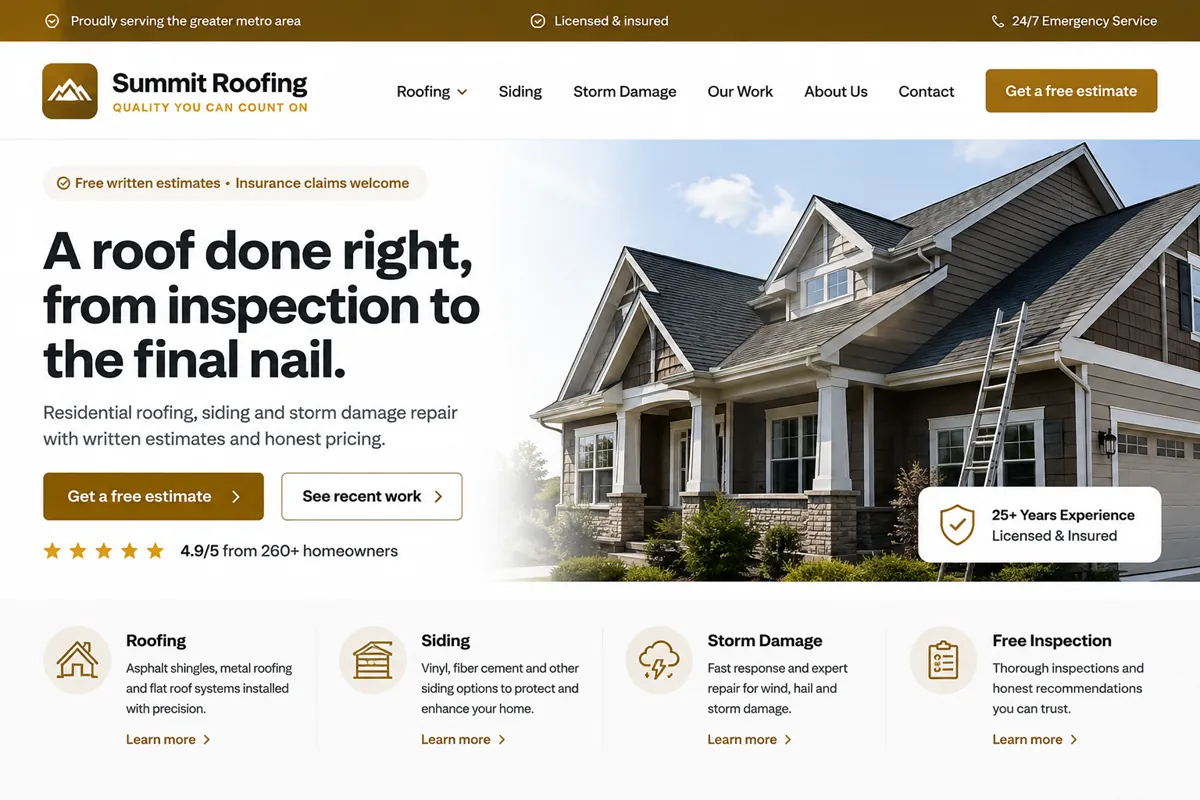
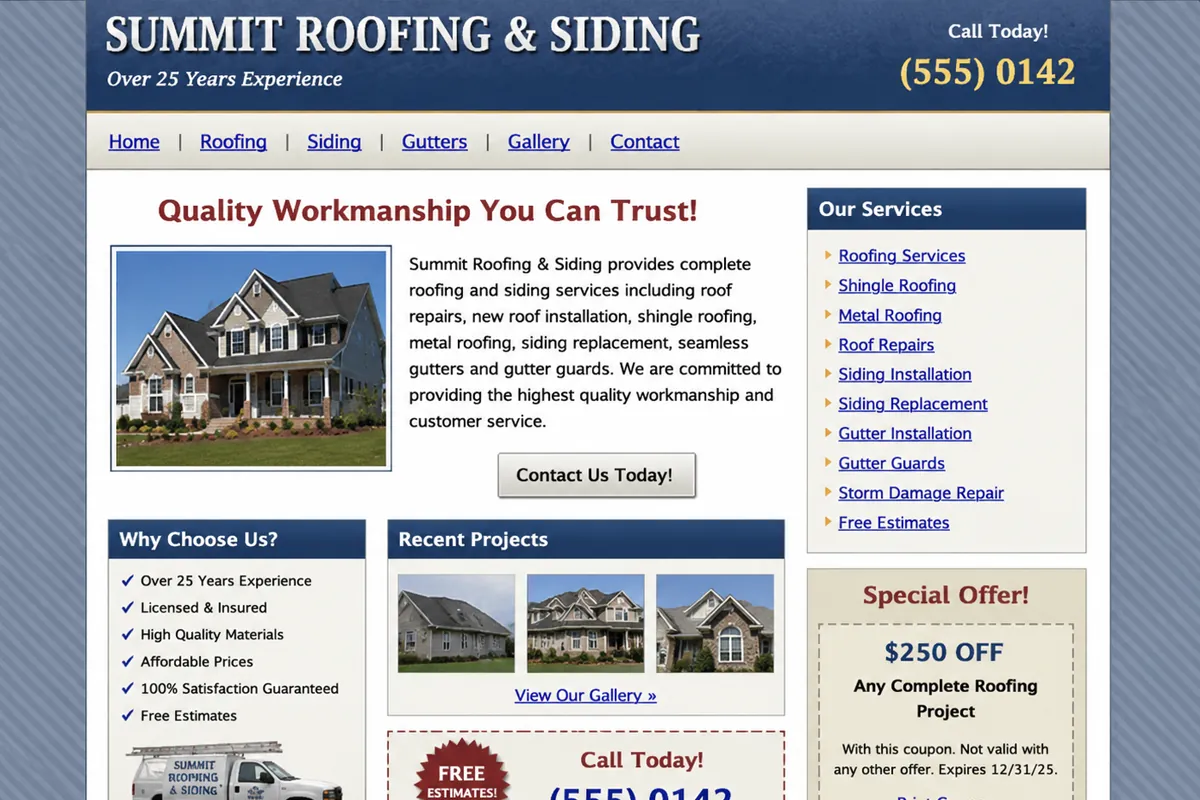
- Project photography turned into a structured, browsable portfolio
- Estimate request promoted from a nav item to the page-level action
- Storm damage and insurance work given prominence in season
Illustrative mock-ups. The business names, logos, contact details, imagery and ratings shown are fictitious and exist for demonstration only. No real company is depicted, and any resemblance to an actual business is coincidental.
What gets fixed first.
In order. The review tells us how much of this list your site already handles.
- Portfolio restructured so work is filterable by material and job type
- Photographs compressed and sized properly — the gallery is the site
- Estimate request promoted to the page-level action everywhere
- A storm damage and insurance claims page ready before the season
- Licensing, insurance and warranty surfaced as visible trust signals
What roofing contractors ask us.
We have thousands of job photos. What do we do with them?
Not all of them go on the site. We pick a working set that covers each material and job type, compress and size them properly, and build a structure that stays browsable as you add more. A curated fifty-photo portfolio outperforms an unnavigable two thousand.
Should we build separate pages for each town we cover?
Only where you genuinely work and can say something specific — the neighborhoods, the housing stock, jobs you have finished there. Thin pages that swap one town name for another are the exact pattern search engines discount, and they can hurt the rest of the site.
How do we handle the storm rush without the site falling over?
The rebuild is static and served from a CDN, so a traffic spike is a non-event. The part that needs planning is the intake: an inspection request path that keeps working when fifty people use it in an afternoon, and a clear statement of what happens next.
The same problem, different business.
Want this for your roofing business?
Send us your current site and we will tell you which of the changes above would make the biggest difference first.
No obligation, and no pressure to rebuild everything.