Website redesign for plumbing companies.
Most plumbing websites are built like brochures for a business that sells emergencies. The gap between those two things is where the calls go.
Somebody with water on the floor is not going to browse your site.
Plumbing is one of the few trades where a large share of visitors arrive mid-problem, on a phone, standing next to the thing that is leaking. They have three tabs open and they are calling whichever one makes it easiest. A site that opens with a welcome message and a company history is answering a question nobody on that page is asking.
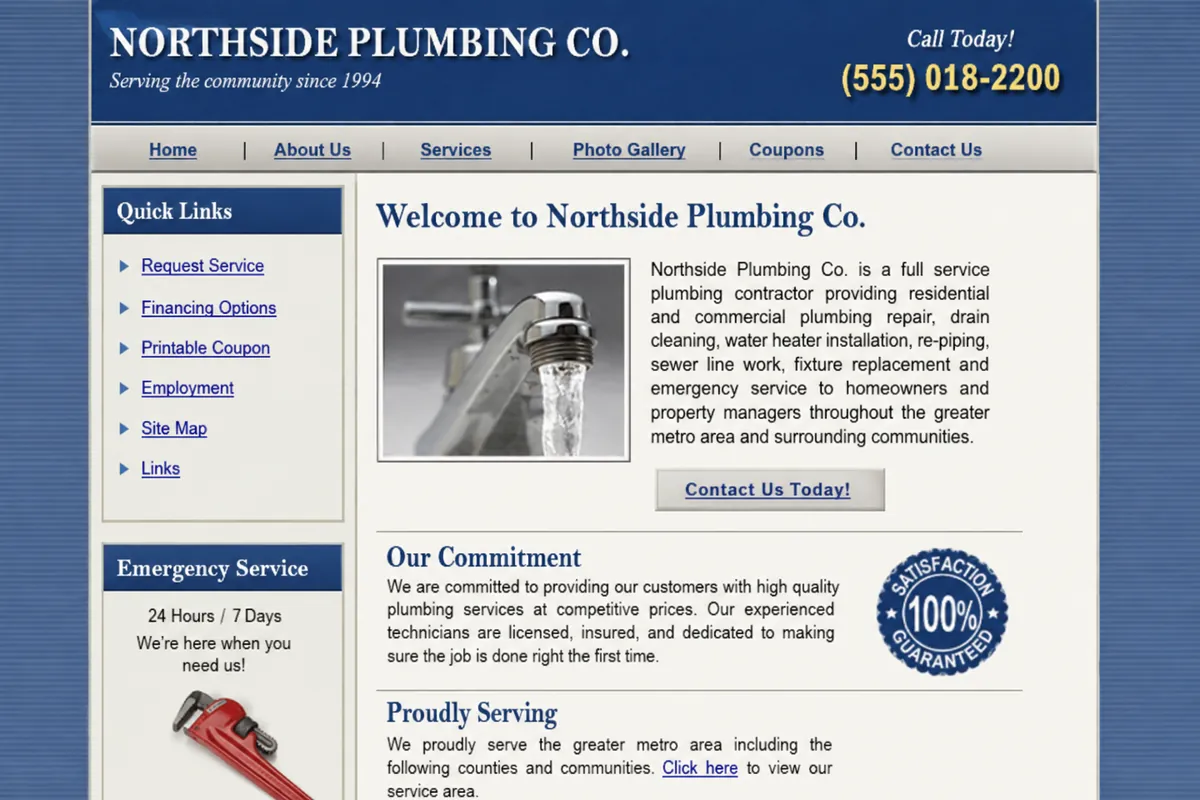
- The phone number sits in a header image, so tapping it does nothing
- Emergency and after-hours service is a sub-page rather than the first thing on screen
- Fourteen services described in one dense paragraph instead of scannable cards
- No service area list, so nobody knows whether you even cover their town
- A contact form as the only route in, answered whenever somebody next checks it
Three visitors, three different jobs.
A redesign that treats these as one audience serves none of them. Each gets its own path through the site.
The emergency
Burst pipe, backed-up drain, no hot water. They need a tappable number, a plain statement of whether you come out today, and confirmation that you cover where they live. Nothing else on the page matters to them.
The planned job
A repipe, a water heater replacement, a bathroom fit-out. This visitor is comparing two or three companies and wants evidence of competence: real photos of your work, licensing, how estimates work, and what happens after.
The property manager
Repeat commercial work, and the most valuable visitor on the site. They are looking for account terms, response times and whether you handle multiple sites — usually none of which appears anywhere.
What that looks like rebuilt.
A concept for plumbing company, not client work — the business is invented and the phone number is fictional.
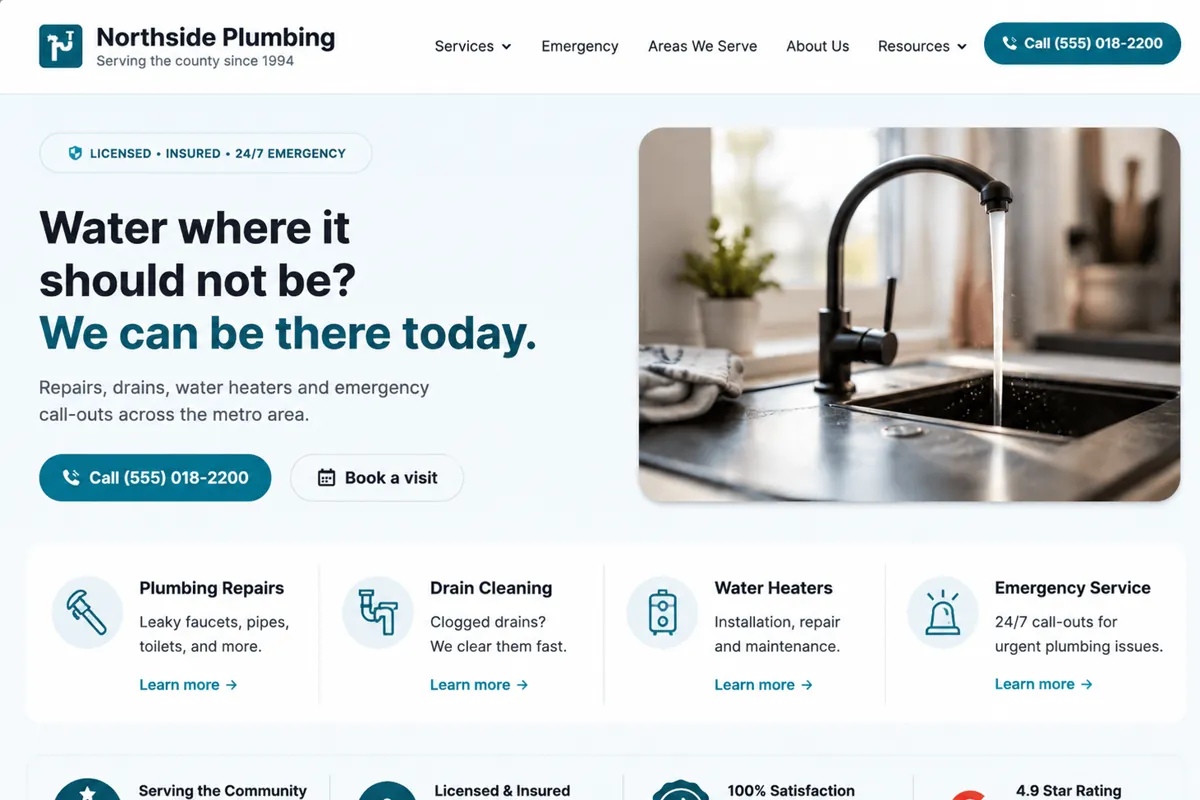
- Phone number became the primary action on every screen
- Emergency service moved above the fold instead of into a sub-page
- Six services untangled from one paragraph into scannable cards
Illustrative mock-ups. The business names, logos, contact details, imagery and ratings shown are fictitious and exist for demonstration only. No real company is depicted, and any resemblance to an actual business is coincidental.
What gets fixed first.
In order. The review tells us how much of this list your site already handles.
- Tappable phone number fixed to the screen on mobile, on every page
- Emergency availability stated in the first screenful, not implied
- Each service given its own findable page instead of a bullet in a list
- Service areas built as real, structured pages people can search for
- Estimate and booking paths that work one-handed, at 11pm
What plumbing companies ask us.
Will a new website actually get us more calls?
We will not put a number on it, because nobody honestly can. What we can say is what changes: a tappable number instead of an image, emergency service visible without scrolling, and service areas that exist as pages. Those remove specific, identifiable reasons a ready-to-call visitor leaves. Whether that turns into more calls depends on how many people are finding you in the first place.
We get most of our work from word of mouth. Does the site matter?
It matters more, not less. A referral almost always checks the website before calling — that is the moment the site either confirms the recommendation or quietly undercuts it. Word-of-mouth businesses usually have the strongest reputation and the weakest site, which is the widest gap worth closing.
Can you keep our existing phone number tracking and booking system?
Yes. Call tracking, booking widgets and dispatch software are integrated rather than replaced, unless the tool itself is the reason the site is slow. If that is the case we will tell you and let you decide.
The same problem, different business.
Want this for your plumbing business?
Send us your current site and we will tell you which of the changes above would make the biggest difference first.
No obligation, and no pressure to rebuild everything.